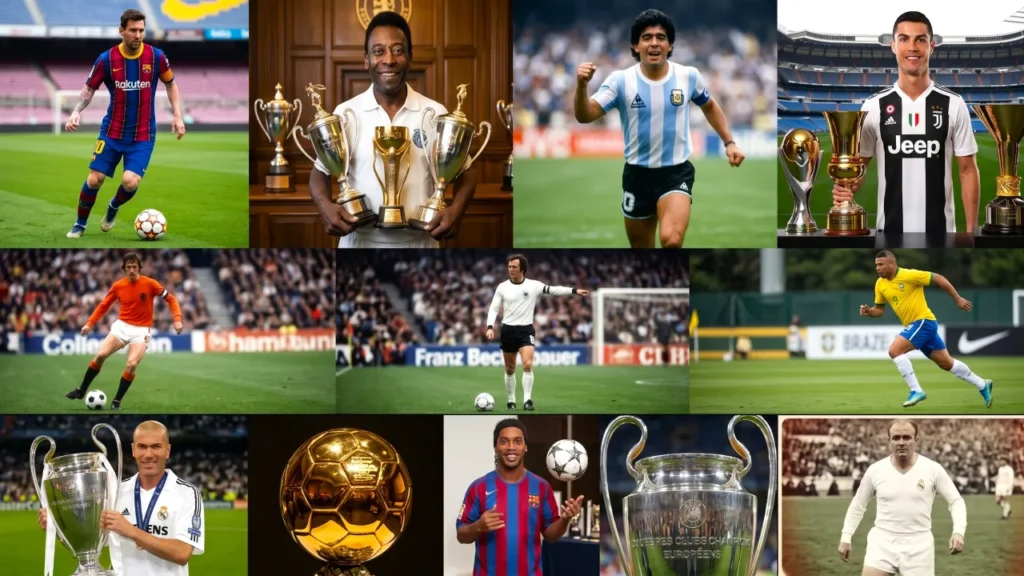
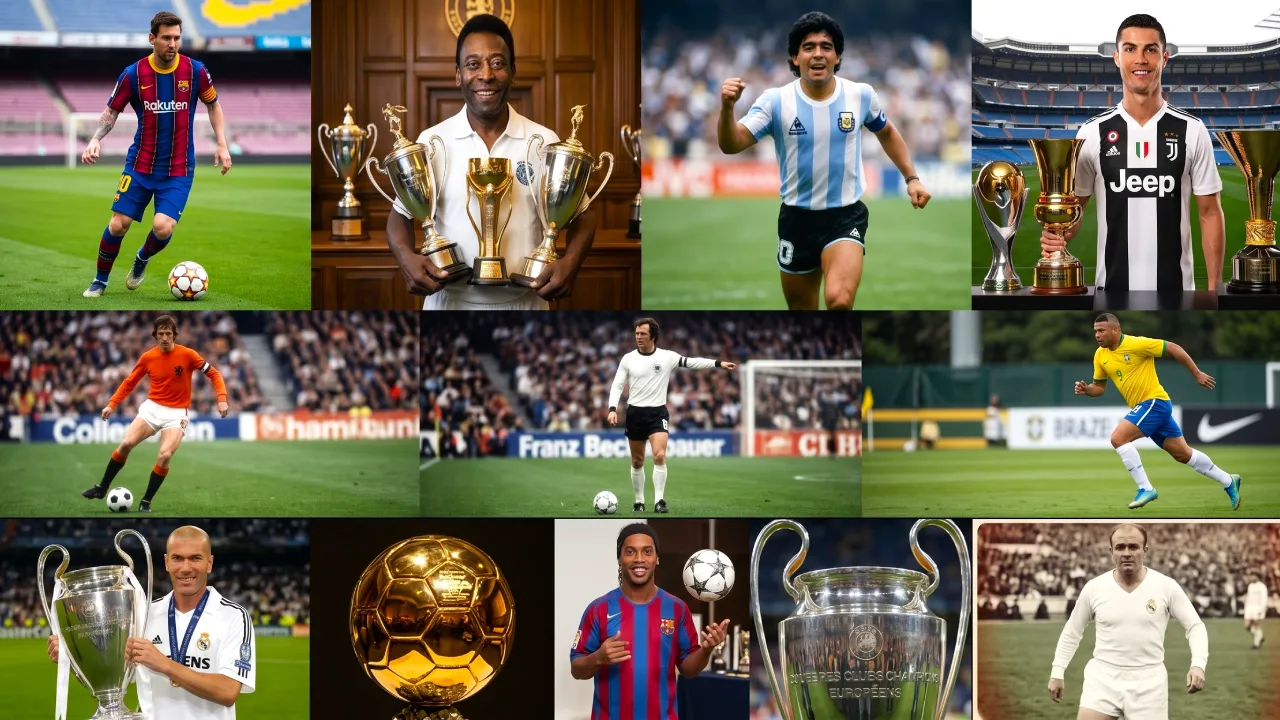
Football has produced extraordinary players across generations, from the pioneers of the early modern era to the global superstars of today. Some dominated through goalscoring, others through creativity, tactical intelligence, leadership or technical brilliance.
There is no universally accepted list of the greatest soccer players of all time, because different generations and playing positions are difficult to compare directly. However, the following ten football legends have had an exceptional influence on the sport and left an enduring mark on football history.
1. Lionel Messi 🇦🇷
International career: 2005–present
International matches: 207
International goals: 125
Lionel Messi has built one of the most decorated international careers in modern football. The Argentine forward eventually reached the pinnacle of international football by leading Argentina to victory at the 2022 FIFA World Cup.
Messi's extraordinary combination of dribbling, close control, vision, passing and goalscoring has made him one of the defining players of his generation. His ability to create opportunities as both a scorer and playmaker has distinguished him throughout his career.
His international success added another major chapter to a career already filled with individual and club achievements.
2. Pelé 🇧🇷
International career: 1957–1971
International matches: 92
International goals: 77
Pelé remains one of the most recognizable names in football history. The Brazilian forward played a central role in Brazil's success during the 1950s, 1960s and early 1970s.
His greatest international achievement was winning three FIFA World Cups, in 1958, 1962 and 1970. His goalscoring ability, athleticism and technical skills helped establish him as a global sporting icon.
Pelé also played an important role in transforming football into an increasingly international and commercially visible sport.
3. Diego Maradona 🇦🇷
International career: 1977–1994
International matches: 91
International goals: 34
Diego Maradona was renowned for his extraordinary dribbling, creativity and ability to influence matches almost single-handedly.
His defining international achievement came at the 1986 FIFA World Cup, where he played a central role in Argentina's championship campaign. His performances during the tournament became some of the most memorable moments in World Cup history.
Maradona's combination of technical ability, imagination and competitive personality made him one of the most influential footballers of the 20th century.
4. Cristiano Ronaldo 🇵🇹
International career: 2003–present
International matches: 234
International goals: 146
Cristiano Ronaldo has enjoyed one of the longest and most productive international careers in men's football. He has represented Portugal for more than two decades and has established records for international appearances and goals.
Ronaldo helped Portugal win the UEFA European Championship in 2016 and the UEFA Nations League. His career has been defined by exceptional goal scoring, physical conditioning, aerial ability and consistency.
His longevity at the highest level has also made him one of the most recognizable footballers in the world.
5. Johan Cruyff 🇳🇱
International career: 1966–1977
International matches: 48
International goals: 33
Johan Cruyff was one of the most important figures associated with Total Football, the tactical philosophy strongly associated with the Netherlands during the 1970s.
Cruyff combined technical skill with exceptional football intelligence. His movement, passing, dribbling and understanding of space allowed him to influence games in multiple areas of the pitch.
His influence extended beyond his playing career, as his ideas continued to shape coaching and tactical development in modern football.
6. Franz Beckenbauer 🇩🇪
International career: 1965–1977
International matches: 103
International goals: 14
Franz Beckenbauer was one of the most influential defenders in football history. Often associated with the modern libero or sweeper role, he demonstrated that a defender could also initiate attacks and control play from deep positions.
Beckenbauer captained West Germany to the 1974 FIFA World Cup and became renowned for his composure, passing and ability to carry the ball forward.
His tactical influence helped reshape perceptions of the defensive position.
7. Ronaldo Nazário 🇧🇷
International career: 1994–2011
International matches: 98
International goals: 62
Ronaldo Nazário, commonly known simply as Ronaldo, was one of the most devastating strikers of his generation.
He combined explosive acceleration, close control, powerful finishing and exceptional technical ability. Despite serious injury problems during his career, he returned to the highest level and played a major role in Brazil's 2002 World Cup triumph.
Ronaldo's ability to beat defenders and finish chances with both feet made him a defining striker of his era.
8. Zinedine Zidane 🇫🇷
International career: 1994–2006
International matches: 108
International goals: 31
Zinedine Zidane was celebrated for his exceptional ball control, vision, passing and composure under pressure.
He became a central figure in France's golden generation, helping the national team win the 1998 FIFA World Cup and UEFA Euro 2000.
Zidane's elegant playing style and ability to perform in major matches made him one of the most memorable midfielders in football history.
9. Ronaldinho 🇧🇷
International career: 1999–2013
International matches: 97
International goals: 33
Ronaldinho combined creativity, technical skill and entertainment in a way few footballers have matched.
The Brazilian star became particularly famous for his dribbling, inventive passing, ball control and spectacular skills. His ability to produce unexpected moments on the pitch made him one of the most entertaining footballers of his generation.
Beyond his statistics, Ronaldinho's influence can be seen in the way his distinctive style inspired younger players around the world.
10. Alfredo Di Stéfano 🇦🇷🇪🇸
International career: 1947–1961
International matches: 37
International goals: 29
Alfredo Di Stéfano was one of the most influential players of the early modern era and a central figure in Real Madrid's emergence as a European football powerhouse.
Unlike many traditional forwards, Di Stéfano contributed across the pitch. His versatility, intelligence, work rate and goalscoring ability allowed him to influence both attacking and defensive phases of play.
His role in Real Madrid's early European success established him as one of the foundational figures of the club's international legacy.
A Legacy Across Generations
The history of football cannot be understood through statistics alone. Players from different eras faced different tactical systems, competition structures, training methods and styles of play.
Pelé and Di Stéfano helped define an earlier generation of global football. Cruyff and Beckenbauer influenced the tactical evolution of the sport, while Maradona, Ronaldo Nazário, Zidane and Ronaldinho became symbols of technical and creative excellence.
The modern era has been dominated by extraordinary careers from Lionel Messi and Cristiano Ronaldo, whose international longevity and statistical achievements have added another chapter to football history.
Ultimately, discussions about the greatest soccer players of all time depend on the criteria being considered. International success, club trophies, individual awards, statistics, technical ability, longevity, leadership and influence on football can all provide different perspectives.
What remains undisputed is that these ten players have contributed significantly to the history and global development of the world's most popular sport.