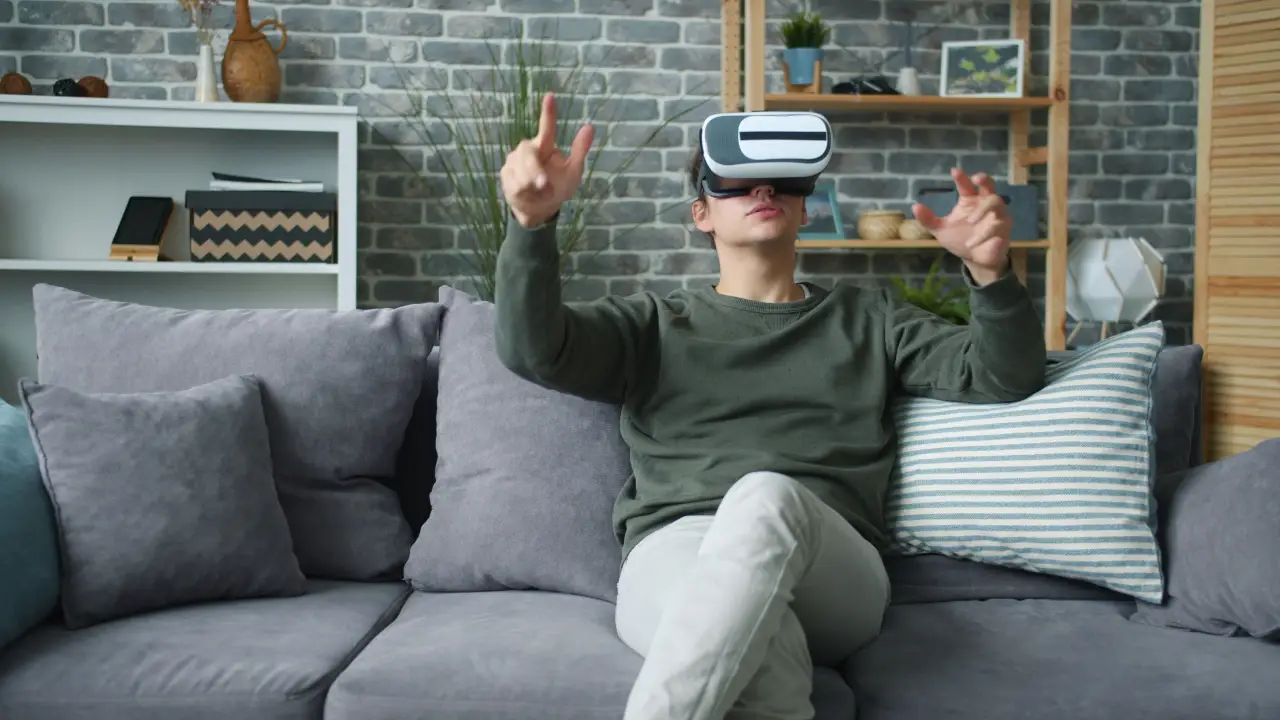
Virtual Reality (VR) glasses, more accurately known as VR headsets, are evolving from gaming devices into sophisticated computing platforms. By combining high-resolution displays, motion sensors, cameras, spatial audio, hand tracking and eye tracking, VR allows users to interact with digital environments in a more immersive way.
The technology is increasingly moving toward Mixed Reality (MR) and spatial computing, where digital information can interact with the physical world rather than remaining confined to a traditional screen.
1. What Are VR Glasses and How Do They Work?
VR headsets use displays and optical lenses to create separate images for each eye, producing a three-dimensional experience. Motion sensors track the user's head movements and adjust the virtual environment in real time.Modern systems can also use cameras and environmental sensors to map surroundings, track hands and support mixed-reality experiences. Spatial audio adds another layer of realism by positioning sounds around the user.
Hand and eye tracking are also becoming increasingly important, allowing people to interact with virtual content without relying entirely on traditional controllers.
2. VR, AR and Mixed Reality
Although often grouped together, VR, Augmented Reality (AR) and Mixed Reality (MR) provide different experiences.Virtual Reality (VR) replaces the user's visual environment with a computer-generated world. Augmented Reality (AR) adds digital information to the physical environment, while Mixed Reality (MR) allows virtual objects and the physical world to coexist and interact.Modern VR platforms increasingly combine these technologies.
For example, color passthrough cameras can display the user's surroundings inside a headset while digital objects are placed within the physical environment.
3. Beyond Gaming: Education, Healthcare and Industry
Gaming remains one of VR's most visible applications, but immersive technology is expanding into professional fields.In education, students can explore three-dimensional environments, anatomical models, laboratories and engineering simulations. In healthcare, VR can support medical education, procedural training, rehabilitation and certain therapeutic applications.
Manufacturing and industrial organizations can use VR to train employees in equipment operation, safety procedures, workflows, maintenance and emergency situations without interrupting real-world operations.
The pharmaceutical industry is another potential application. Virtual pharmaceutical facilities could allow employees to practice processes such as dispensing, granulation, compression, coating, packaging and quality-control procedures. Simulated deviations could also provide opportunities to practice decision-making and corrective actions.
VR would not replace practical training, GMP documentation or qualified personnel, but it could complement conventional training with realistic simulations.
4. The Workplace and the Rise of Spatial Computing
VR and MR are increasingly being explored for workplace training, remote collaboration, design visualization and hands-free workflows.Architects and engineers can use immersive environments to examine buildings and industrial facilities before construction. Teams can virtually evaluate space utilization, equipment positioning, production flows, safety considerations and facility layouts.
Mixed Reality can take this further by placing digital information directly within physical spaces. A technician could see instructions beside machinery, an engineer could visualize a component before manufacturing it, or a student could interact with a virtual laboratory within a classroom.
This reflects a broader shift from traditional screen-based computing toward spatial computing, where digital information becomes connected to the environment around the user.
5. Lighter Devices, Bigger Opportunities
One of the industry's major challenges has been the size and weight of VR hardware. Manufacturers are therefore working toward lighter and more wearable devices.
At Meta Connect 2026, Meta announced a new generation of VR glasses designed for immersive entertainment and productivity, with the company stating that the devices weigh about 100 grams and are expected to ship in spring 2027.
The broader smart-glasses market is also expanding. IDC reported that global smart-glasses shipments increased 167% year over year in Q1 2026, highlighting the growing interest in wearable computing.
6. Challenges and the Future of VR
Despite rapid progress, VR still faces challenges including cost, comfort, motion sickness, limited content, privacy concerns and adoption barriers.Cameras, microphones, eye tracking and environmental mapping also raise important questions about personal and workplace data.The future of VR is unlikely to involve smartphones and computers disappearing overnight.
Instead, computing may gradually become more spatial and immersive.Computer screens → Smartphones → Smart glasses → Mixed Reality → Spatial computingUsers may increasingly interact with digital information through voice, eye movements, hand gestures and AI rather than relying exclusively on traditional screens.
Ultimately, the importance of VR glasses will depend on how effectively they solve real-world problems. For gamers, they can provide deeper immersion; for students, interactive learning; for healthcare professionals, realistic training; and for businesses, new ways to train, design, collaborate and visualize information.
The bigger question is no longer simply whether VR can create a virtual world, but what we can accomplish when digital information becomes part of the space around us.